
Witches
Baba Yaga: A Threshold, Not a Villain
The hut walks. The fence remembers. And the woman who lives between them was never quite the witch the later stories needed her to be.
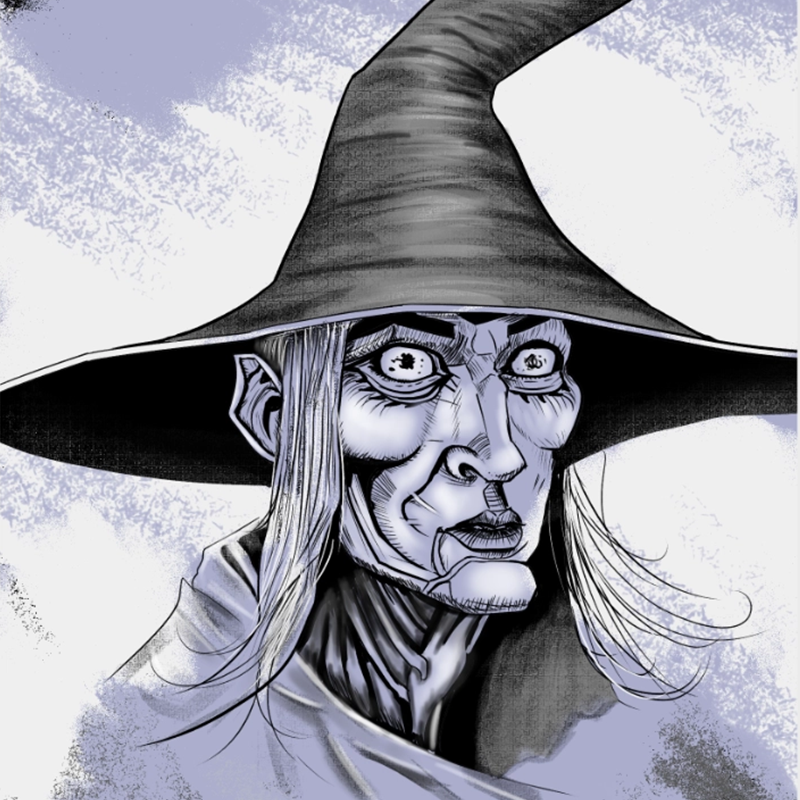
Plate I — Baba Yaga
One of the most persistent images associated with Baba Yaga is her hut: a wooden dwelling standing on bird-like or chicken legs, sometimes able to turn or reposition itself. Not floats, not creaks in a high wind — walks, on legs that end in claws, turning on the spot when you ask it to, the way a dog turns to face a stranger before its owner does. Everything else about Baba Yaga is argued over: her age, her appetite, whether she is one woman or three sisters sharing a name out of convenience. The hut is not argued over. The hut is the one detail that survives every retelling intact, and it is worth asking why, before asking anything about her at all.
I think the hut survives because it is the actual subject of the story. Baba Yaga herself is often almost a formality — a face to put on the door you have to knock on. What the tales are really about is arriving somewhere that has clearly decided, on its own authority, whether you are allowed to be there.
I think the hut survives because it is the actual subject of the story. Baba Yaga herself is often almost a formality — a face to put on the door you have to knock on. What the tales are really about is arriving somewhere that has clearly decided, on its own authority, whether you are allowed to be there.
Say the correct words — izbushka, izbushka, turn your back to the forest and your front to me — and the hut rotates to show you its door. Fail to say them, or say them wrong, and you simply stand in the woods with a house’s spine turned toward you, learning exactly how unwelcome you are. No spell in the wider catalogue of this Archive is so purely about etiquette. It is not a lock. It is a house deciding, in real time, whether it likes your manners.
A House That Chooses
That detail alone tells you Baba Yaga was never meant to be fought. You cannot out-muscle a house. You can only address it correctly, the way you would address an elder whose patience you have not yet earned. Every hero who succeeds in these tales succeeds by being polite to furniture, feeding the dog, oiling the gate, thanking the birch tree for not whipping their eyes out — and every hero who fails, fails at exactly that, not at swordplay.
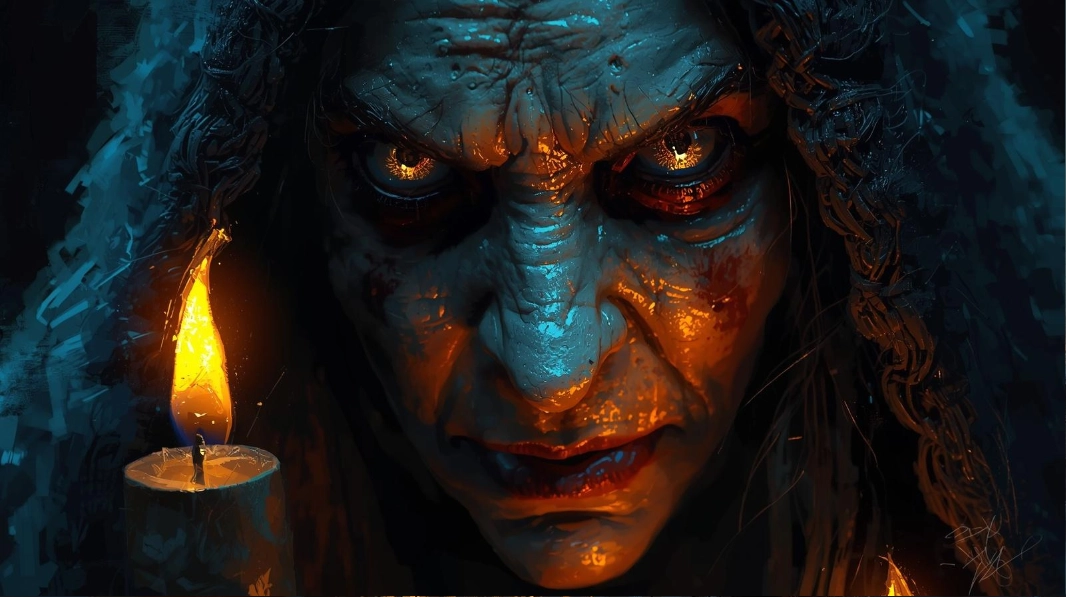
The Fence and What Guards
The fence around Baba Yaga’s dwelling is no ordinary boundary. In some of the best-known Russian tales it is built from human bones, with skulls mounted above the posts. The image is unmistakably threatening, but its narrative function reaches beyond simple horror.
The fence marks a border between two worlds: the ordered human settlement and the dangerous space of the forest. Crossing it means accepting Baba Yaga’s rules. Beyond that boundary, ordinary social protections no longer apply.
In Vasilisa the Beautiful, the skulls even become sources of supernatural light. What appears first as a warning later becomes an instrument carried back into the human world. Baba Yaga’s symbols repeatedly work this way: dangerous, useful, and difficult to classify as either benevolent or evil.
“She does not punish the rude. She simply stops being available to them — which, in a house with legs, amounts to the same thing.”
— marginal note, Archive Folio 14, hand unrecorded
The first thing every telling agrees on is that the hut moves. Not floats, not creaks in a high wind — walks, on legs that end in claws, turning on the spot when you ask it to, the way a dog turns to face a stranger before its owner does. Everything else about Baba Yaga is argued over: her age, her appetite, whether she is one woman or three sisters sharing a name out of convenience. The hut is not argued over. The hut is the one detail that survives every retelling intact, and it is worth asking why, before asking anything about her at all.
I think the hut survives because it is the actual subject of the story. Baba Yaga herself is often almost a formality — a face to put on the door you have to knock on. What the tales are really about is arriving somewhere that has clearly decided, on its own authority, whether you are allowed to be there.
The Story Everyone Tells Slightly Differently
I think the hut survives because it is the actual subject of the story. Baba Yaga herself is often almost a formality — a face to put on the door you have to knock on. What the tales are really about is arriving somewhere that has clearly decided, on its own authority, whether you are allowed to be there.
Field Notes
CULTURE
Best documented in Russian folk tradition, with related figures and motifs appearing across the wider Slavic world. Baba Yaga belongs primarily to the East Slavic fairy-tale tradition rather than to a single historical religion or region.
LOCATION
Baba Yaga typically inhabits the remote forest, separated from villages, roads, and cultivated land. Her dwelling marks a narrative boundary between the familiar human world and a supernatural domain governed by different rules.
PECULIARITIES
Her most recognizable attributes are the hut standing on bird- or chicken-like legs, the mortar in which she travels, the pestle used to propel it, and the broom with which she erases her trail. In several tales her dwelling is surrounded by a fence made from human bones and skulls.
CHARACTERISTICS
Baba Yaga may threaten, devour, interrogate, test, advise, or assist those who enter her domain. Her role changes from tale to tale: sometimes antagonist, sometimes donor of magical knowledge or objects, and sometimes an uneasy combination of both. She is therefore better understood as an unstable and liminal figure than as a consistently benevolent or malevolent witch.
FIRST DOCUMENTED REFERENCE
1755 — Mikhail Lomonosov, Russian Grammar
One of the earliest clear written references to Baba Yaga appears as Iaga Baba in Mikhail Lomonosov’s Russian Grammar of 1755. Her oral tradition is almost certainly considerably older than this surviving written record.