Threat Classification: Variable — Context Dependent
Recommendation: Approach only with preparation, respect, and a willingness to be changed

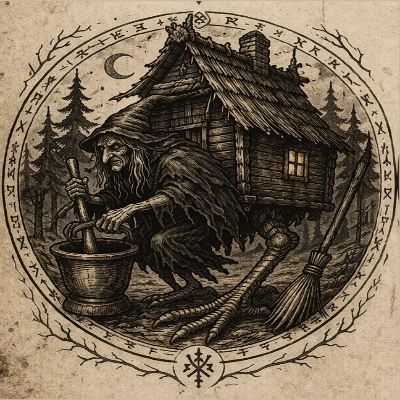
An ancient, shape-shifting forest crone bound to a living hut on chicken legs, Baba Yaga embodies the wild, liminal boundary between worlds, moving through the deep woods with elemental, nature-bound magic.
| Form / Type | Liminal witch-entity; an ancient forest being that exists between spirit and flesh |
| Physical Appearance | Often depicted as an emaciated crone with iron teeth, long limbs, and piercing, inhuman eyes; her form may shift subtly depending on the observer |
| Dwelling | A crooked hut standing on chicken legs, capable of movement and rotation; often surrounded by a fence of bones or skulls |
| Mobility | Travels in a mortar, propelling herself with a pestle; sweeps away her tracks with a broom made of branches |
| Environmental Aura | The forest bends around her presence—trees creak, animals fall silent or obey, and paths become disorienting |
| Domain | Deep forest edges and thresholds—places where the boundary between worlds (life/death, human/spirit) is thin |
| Associated Creatures | Wolves, ravens, owls, and other forest beings that act as watchers, servants, or extensions of her will |
| Magical Expression | Commands elemental and primal forest forces; magic feels ancient, organic, and inseparable from nature itself |
| Age / Presence | Timeless; represents ancestral memory, cyclical time, and the enduring will of the wild rather than a fixed lifespan |

A morally ambiguous guardian of thresholds, she tests those who seek her out—rewarding the clever and respectful while punishing the foolish—acting as both devourer and initiator guided by ancient, non-human laws.
| Disposition | Deeply ambiguous—can be guide, devourer, or tester depending on circumstance and behavior of those who encounter her |
| Moral Alignment | Not bound by human morality; operates on ancient, often harsh but internally consistent laws |
| Core Archetype | Guardian of thresholds; initiator of transformation through trials, fear, or sacrifice |
| Threat Nature | Extremely powerful but judicial rather than purely predatory—danger arises from failing her tests or disrespecting her domain |
| Interaction Style | Engages primarily with the lost, the desperate, or children; presents riddles, tasks, or moral trials |
| Tests & Trials | Challenges individuals to prove courage, humility, cleverness, or respect for natural/spiritual order |
| Role in Myth | Acts as both obstacle and enabler—those who survive her trials often gain power, knowledge, or passage |
| Relationship to Humans | Views humans as transient and often foolish, yet occasionally worthy of guidance or transformation |
| Symbolism | Embodies the wild unknown, the inevitability of change, and the harsh wisdom of nature and time |
Her name is hard to pin down to a single meaning. Baba is an old word for an elderly woman—a grandmother, a crone, an ancestor. Yaga is darker. It speaks of fear, pain, and anger. Put together, the name carries a contradiction. Baba Yaga is both the one who gives life and the one who takes it away. She can be a protector—or a disaster.
Across the Slavic world, people knew her by many names. In Czech lands, she was called Ježibaba. Among the South Slavs, she became Baba Roga. In the Carpathian mountains, some whispered of Mat’ Lesa, the Mother of the Wood. The names changed, but the presence stayed the same.
Her home was always the forest—not just any forest, but the deep, old woods stretching from the lands of Rus’ toward the Ural Mountains. These were places where paths vanished and rules no longer applied. Some believe Baba Yaga is older than history itself, born from ancient beliefs that existed before churches, before kingdoms, before written words.
She appears in written records as early as the Middle Ages, but her stories are far older. Long before they were written down, people told them by firelight. Some say her roots reach back to a time when humans lived at the mercy of the forest—when its spirits were not symbols or stories, but forces that decided who lived and who did not.

Baltic fragments hint at kinship with older forest hags, while Finno-Ugric parallels suggest a more unsettling theory: Baba Yaga may not be a singular entity, but rather a mantle—an ancient office assumed, relinquished, and inherited across epochs.
Ježibaba in Czech regions
Baba Roga among South Slavs
Mat’ Lesa (Mother of the Wood) in Carpathian accounts

Baba Yaga cannot be placed neatly on any moral scale. In the same story, she may appear cruel, generous, or utterly indifferent, shifting roles without explanation. Some who meet her are devoured. Others are guided, armed with knowledge or gifts that change their fate. Because of this, many scholars argue she is not driven by malice at all, but by trial. .She behaves like an examiner standing at a threshold, weighing those who come before her. She tests patience, humility, and awareness, and only then decides whether aid is deserved. What is clear is that her movements follow moments of change. She is most active at twilight, during seasonal turning points, and at times when the world itself feels unstable—first frost, sudden thaw, endings and beginnings. Baba Yaga exists between states, never fully anchored to one role or time. She is not chaos, but transition made flesh, appearing where certainty ends and something else must begin.
Baba Yaga does not belong to good or evil in any clean way. In the stories, she shifts constantly—hostile in one moment, helpful in the next, and sometimes utterly indifferent to human suffering. A traveler may come to her starving and frightened and be eaten without mercy, while another, arriving under nearly the same circumstances, is fed, tested, and sent away wiser than before. This contradiction is not a flaw in the tales. It is the point.
Many scholars believe Baba Yaga is not driven by cruelty, but by trial. Hunger is often named as her motive, and sometimes it is very real—she is said to consume flesh and bone without shame. But just as often, that hunger is symbolic. She feeds on fear, on failure, on those who arrive unprepared for the forest and its laws. She does not hunt. She waits.
When humans come before her, Baba Yaga becomes an examiner. She sets tasks that seem pointless or impossible: sorting grain from ash, cleaning her house, tending fires that must not die. These trials are never about strength. They are about patience, respect, and attention. Those who complain, rush, or assume entitlement are destroyed. Those who listen, endure, and show humility may survive—and even be rewarded.
If she helps, it is rarely out of kindness. She helps because something must continue. A journey must be completed. A balance must be restored. In this way, Baba Yaga acts less like a villain and more like a force of nature—harsh, ancient, and unmoved by excuses.
She does not simply consume- she tests and only then decides what remains.
The House That Walks and Watches
Baba Yaga’s home is as feared as its mistress. Deep in the forest, where paths fade and trees grow close together, stands her hut—the izba na kur’ikh nozhkakh. It does not rest on the ground like a proper house. Instead, it balances on enormous chicken legs, creaking and shifting as if alive. At times it turns its back on visitors, refusing entry. At others, it slowly rotates, as though deciding whether the one who approaches is worth noticing at all.
The forest around the hut is thick and trackless, a place where direction is easily lost and sound carries strangely. Encircling the dwelling is a fence made not of wood, but of human bones. Skulls crown the posts, their hollow eyes glowing with an unnatural light that flickers even when no fire burns. These lights do not guide travelers to safety. They warn.
Baba Yaga does not appear without cause. Most who encounter her do so after a mistake—wandering too far from known roads, breaking an unspoken rule of the woods, or crossing into places meant to remain untouched. Others seek her out deliberately, performing old rituals, leaving offerings, and calling her name with care and fear. Even then, there is no guarantee she will answer.
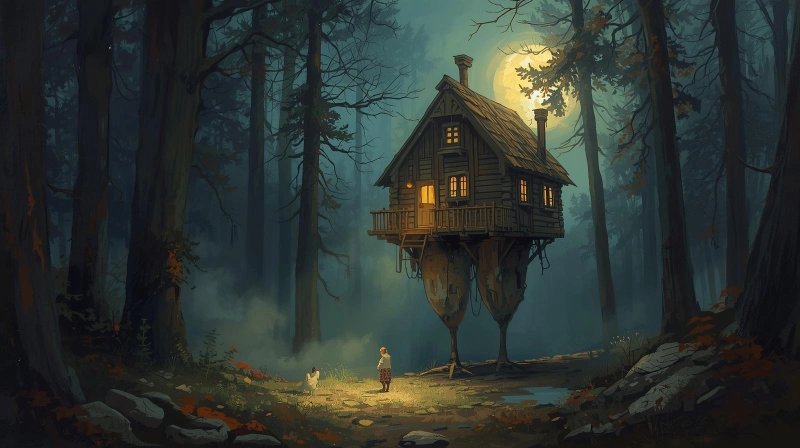
The hut is more than a home. It is a boundary. To stand before it is to stand at the edge of the known world, where the forest decides whether you may pass—or whether you will remain forever among the bones.
Though mobile, Baba Yaga appears intrinsically linked to her hut. Some accounts describe it as an extension of her will; others suggest it is a semi-autonomous entity.
A competing theory posits she is not bound to place at all, but to function—the eternal roles of guardian, devourer, and initiator into hidden knowledge.ior..
Baba Yaga’s power is vast, but it is never careless. The forest itself listens to her. Animals move at her command—wolves, birds, and unseen creatures carrying out her will as naturally as breathing. Storms gather or break apart when she travels, winds bending to her path as her mortar cuts through the sky. Distance means little to her; she can cross immense stretches of land in moments, appearing where she is needed—or feared—without warning. More dangerous still is what she knows. Baba Yaga is said to guard ancient knowledge of life and death, of endings and beginnings, of how one thing becomes another. These secrets are not taught freely. They are earned.
Yet for all her strength, Baba Yaga is bound by old laws she did not create and cannot break. If a guest approaches her properly—invoking the rites of hospitality, offering respect and sustenance—she must honor that bond, no matter her hunger. When she sets a task or poses a riddle, she is bound to see it through. The trial must be completed. The judgment must be delivered. She cannot simply abandon the process once it has begun.
This is the paradox at the heart of Baba Yaga. She is nearly unstoppable, yet never unbound. Her magic is immense, but it moves within strict, ancient rules. In this balance lies her true nature: not chaos, but order of a harsher kind—one that does not bend to desire, only to law.
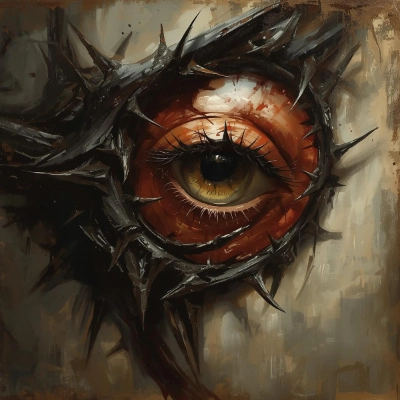
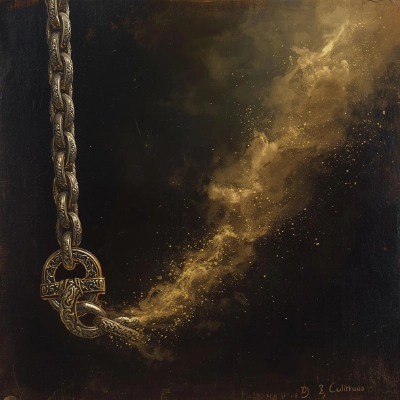
These rules form the paradox of her existence: her greatest power is matched by her greatest limitation.
Encounters and Recorded Testimonies
Those who survive an encounter with Baba Yaga tell similar stories, no matter where the tale is found. It usually begins with desperation. A child is cast out, an exile wanders too far, or a traveler loses the path and steps into the deep forest where the rules of the human world no longer apply. Somewhere beyond fear, the petitioner reaches her domain and makes a request—often for fire, food, protection, or knowledge. Baba Yaga listens, but she never answers directly. Instead, she sets tasks that appear impossible: sorting the unsortable, cleaning what cannot be cleaned, completing work meant to break the spirit. These trials are never about strength. They are traps for arrogance. Survival depends on cleverness, patience, humility, and sometimes help from unexpected allies—animals, enchanted objects, or quiet acts of kindness repaid. Those who boast, complain, or demand are destroyed without ceremony. Those who observe, listen, and adapt may be allowed to leave, changed but alive. In these testimonies, Baba Yaga does not chase or deceive. She waits. The choice to enter her world is always the final test—and once made, there is no turning back.
Encounters follow a consistent narrative structure:
- A desperate petitioner (often a child or exile) enters her domain
- A request for aid is made
- The subject is given impossible tasks
- Outcome hinges on cunning, humility, or external aid

Signs of Presence
Indicators of Baba Yaga’s proximity include:
- Sudden silence among forest fauna
- The scent of smoke without visible flame
- Tracks that begin or end abruptly
- The distant creaking of timber in windless conditions
Reliable identification requires corroboration across multiple signs; isolated phenomena are in
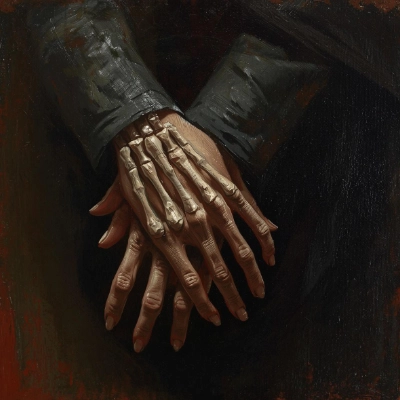
Baba Yaga does not actively seek human contact, yet she responds when approached.
Effective preliminaries include:
- Offerings of bread and salt
- Formal, respectful address
Bargains are possible—but exacting. Terms must be fulfilled precisely. Failure results in consumption—whether corporeal or metaphysical remains disputed.
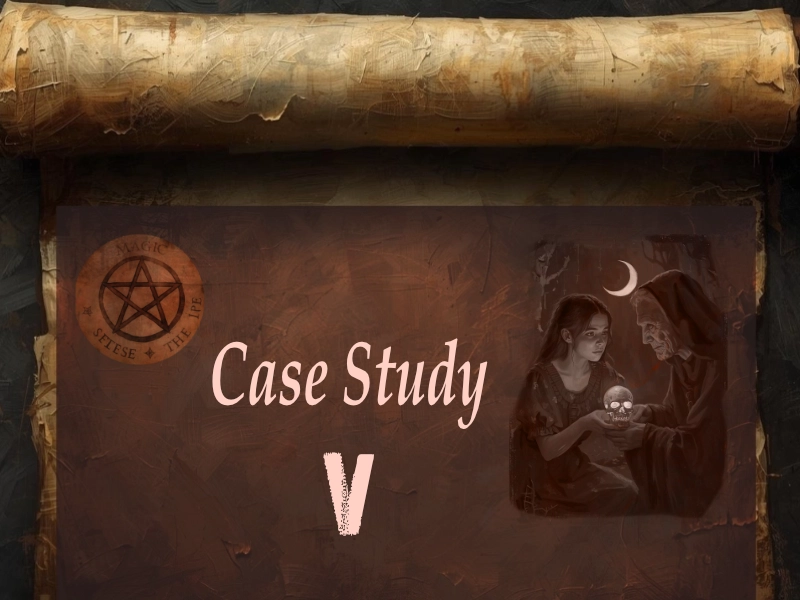
A young girl is sent into the forest to request fire after her household hearth goes dark. Baba Yaga agrees to grant aid only after assigning exhausting domestic labors meant to break the petitioner. Survival is achieved through humility, quiet obedience, and indirect assistance from enchanted helpers. The subject departs alive with a skull‑lantern whose fire destroys her persecutors, indicating Baba Yaga’s gifts may act as instruments of judgment rather than mercy.

Two children, driven from home, arrive at Baba Yaga’s hut under false assurances of reward. The witch issues contradictory tasks designed to ensure failure. The children succeed only by showing kindness to lesser creatures—mice and animals—who intervene on their behalf. Baba Yaga permits their departure, reinforcing a recurring pattern: external aid is granted not by power, but by compassion demonstrated before the trial begins.

A noble exile seeks Baba Yaga’s knowledge to continue a greater quest. She confronts him with trials emphasizing restraint and attentiveness rather than valor. Upon successful completion, she provides directional knowledge and magical assistance but refuses further guidance. This encounter positions Baba Yaga as a gatekeeper—allowing passage but never companionship.

Multiple fragments reference unnamed wanderers who approach Baba Yaga with demands rather than requests. These subjects refuse labor, mock ritual customs, or attempt escape. Outcomes are uniformly fatal. No lesson is delivered, no transformation observed. These cases suggest Baba Yaga does not punish out of cruelty, but erases those who fail to engage correctly with the trial itself.
Cultural Perception and Transformation
In certain traditions, she is revered as:
- Guardian of ancient wisdom
- Keeper of liminal knowledge
- Arbiter of worth
Baba Yaga lingers at the threshold of fear and reverence, a figure neither wholly condemned nor comfortably embraced. In the shifting shadows of Slavic folklore, she is more than a crone of the woods—she is a living paradox, a guardian of ancient wisdom whispered through roots and bones, a keeper of liminal knowledge that exists between worlds, and an arbiter of worth who tests those daring enough to seek her out. Those who approach her with arrogance find only ruin, yet the humble and perceptive may leave transformed, carrying fragments of truths too wild to be spoken aloud. In this way, Baba Yaga resists simple judgment; she is not evil, but elemental—an embodiment of the harsh, necessary forces that shape those who wander too close to the edges of understanding.
Filed under: Forest Entities, Liminal Beings, Trial Archetypes
Threat Classification: Variable — Context Dependent
Recommendation: Approach only with preparation, respect, and a willingness to be changed