Few fictional cities feel as quietly powerful as Ulthar, the ancient dream-city where a single, absolute law shapes everything:
No man may kill a cat.
First appearing in The Cats of Ulthar (1920) by H. P. Lovecraft, Ulthar exists not in waking reality, but within the Dreamlands—a mythic realm accessed through sleep, visions, and forbidden knowledge. Unlike Lovecraft’s later tales of cosmic insignificance, Ulthar feels intimate, eerie, and strangely just, making it a rich source of inspiration for witchy art, dark fantasy prints, and occult aesthetics. [en.wikipedia.org]

A Dreamlike City Suspended in Time
- Fought in the Turkish wars 1700
- Allegedly smashed open the gates of Belgrade using a metal bar
- Bavarian hardened warrior and craftsman
- leading figure in the Bavarian peasant uprising of 1705
- Carried a massive, nail‑studded club said to weigh (over 50 kg)
Ulthar is described as an ancient, tranquil city of narrow cobbled streets and quiet houses, visited by caravans and travelers from distant, unnamed lands. The atmosphere is fairytale‑like, but with an undercurrent of unease—an old place governed by old rules and older forces. [en.wikipedia.org]
Within the Dreamlands, Ulthar stands apart:
- It is more peaceful and civilized than many other dream cities
- It follows a clear moral law, rather than chaotic cosmic indifference
- Its justice is supernatural, indirect, and absolute
This balance of beauty and menace makes Ulthar especially compelling for visual artists drawn to dark folklore, gothic symbolism, and mystical storytelling.
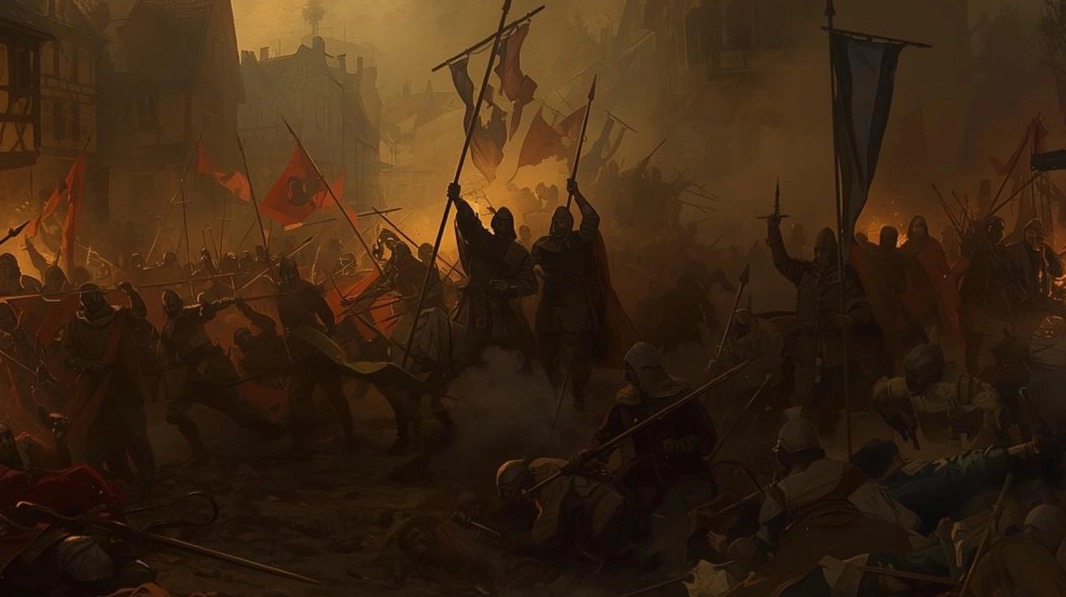
The legend reaches its final, unforgettable image during the Sendlinger Mordweihnacht—the Christmas massacre of 1705. Surrounded by fallen comrades, imperial troops advancing through the snow, the Schmied is said to have fought on alone, refusing surrender, until he was finally killed—still holding the flag
The Law of Ulthar: “No Man May Kill a Cat”
Behind the legend lies a documented historical catastrophe.
The defining feature of Ulthar is its famous law, and the story of how it came to be is both simple and chilling.
Before the law existed, an elderly couple lived on the outskirts of the city. They were known—quietly, fearfully—for killing cats that wandered onto their property. The townspeople suspected them but were too afraid to intervene, choosing instead to guard their own pets closely. [en.wikipedia.org]
Everything changes when a caravan of wanderers arrives, including a mysterious orphan boy named Menes, whose only companion is a small black kitten. When the kitten disappears, Menes learns the truth about the old couple.
That night, Menes performs a strange prayer.
The cats of Ulthar vanish.
By morning, the cats return—fat, well-fed, and content.
The elderly couple is never seen again.
The event is never described directly. Lovecraft leaves the horror implied, making it far more unsettling. In response, the city’s leaders decree a permanent law:
No man may kill a cat in Ulthar.
And so it has remained ever since. [en.wikipedia.org]
Ulthar and the Dreamlands
Ulthar belongs to Lovecraft’s Dream Cycle, a group of stories set in the Dreamlands—a realm governed not by science, but by mythic logic, memory, and ancient gods. [lovecraft.fandom.com]
The Dreamlands are characterized by:
- Timeless cities and forgotten civilizations
- Gods who resemble myth more than monsters
- Journeys that feel symbolic, not geographical
Ulthar appears in later Dreamlands stories, including The Dream-Quest of Unknown Kadath, reinforcing its role as a stable, known place in an otherwise shifting dream-world. [lovecraft.fandom.com] 19th century, a period when Bavaria—like much of Europe—sought heroic narratives to transform historical defeat into moral meaning. The Schmied was not born of superstition, but of national trauma and narrative necessity